
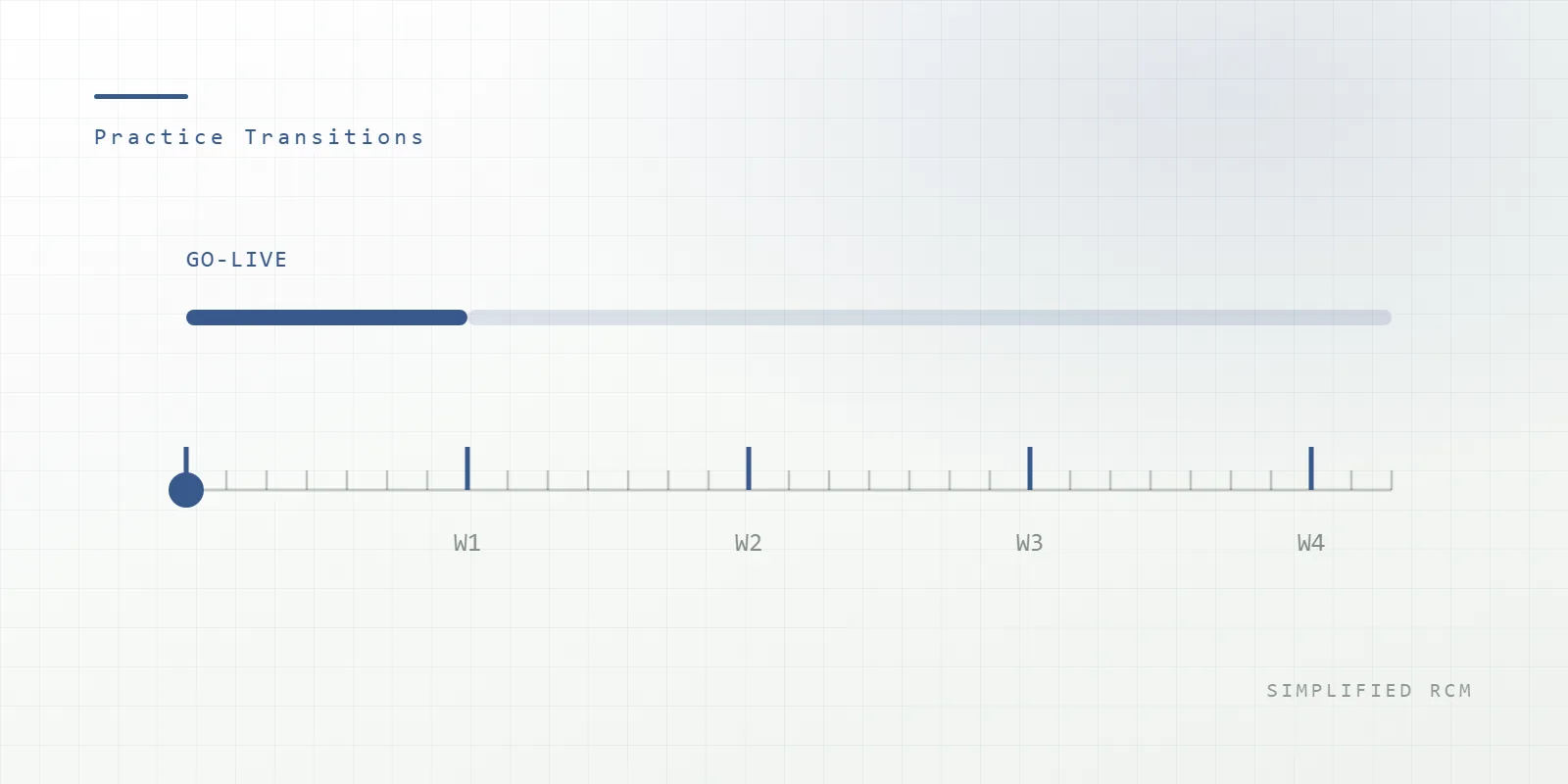
Every EHR vendor will tell you their go-live process is smooth. Every consultant will tell you to expect a bump. Both are right and both are missing the point.
The real risk of an EHR go-live isn’t the EHR. It’s what happens to your billing operation underneath it. Claims start getting dropped. Authorizations stop tracking. Payment posting falls behind because the new ERA file format isn’t quite right. Six weeks in, you’re looking at AR climbing 20-30 days higher than baseline and nobody can quite explain why.
This is the survival guide we wish every practice manager had before going live. Week by week, what to watch, and what to do when something breaks.
Before day one: the checklist nobody finishes
If you’re reading this before your go-live date, the most valuable thing you can do is finish a real pre-flight checklist. Not the one the EHR vendor gives you — that one is about clinical workflows. The billing checklist is yours to build.
Specifically:
- Fee schedules loaded and verified for every payer
- Payer setups complete — enrollment IDs, submitter IDs, and connectivity tested
- Claim edits configured — not the out-of-the-box defaults; the ones that actually match your specialty
- Modifier rules configured for the procedures you actually bill
- Statement and patient billing setup tested with real data
- Reports and dashboards built and tested before day one — you cannot manage what you can’t see
Most practices think they’re ready and discover at day-three that fee schedules are 6 months out of date or that one of their main payers isn’t actually live in the new system. Find this out now, not later.
Week 1: nothing is broken yet — except all the small things
In week 1, your team is learning the new system. Claims aren’t going out yet, or they’re going out slower than usual. That’s expected and not the problem.
The problem is the small things piling up that nobody has time to fix:
- A handful of claims dropped because the new system requires a field the old one didn’t
- Eligibility checks not running because the integration with your verification tool isn’t quite working
- Authorization numbers from the old system that didn’t get migrated cleanly
- Front desk staff entering demographics differently than they used to
None of these will hurt you in week 1. All of them will hurt you in week 4.
What to do: assign one person to log every issue, every day, even tiny ones. Not to fix them all immediately — to make sure nothing gets forgotten. The list will be long. That’s fine. The dangerous list is the one you don’t have.
Week 2: the first claims hit the clearinghouse
This is when reality shows up. Your first batch of claims goes to the clearinghouse and you find out which ones actually go through.
Watch for:
- Clearinghouse rejection rate — if it’s higher than baseline, you have a configuration issue, not a clinical one. Fix it now, not at month end.
- Payer-specific edits that didn’t carry over from the old system
- Claims with the right CPT but the wrong modifier — modifier rules are one of the most commonly mis-configured things at go-live
- Secondary claims not generating automatically (this almost always breaks at go-live)
If you don’t fix these in week 2, they compound. Week 4 you’ll be looking at 200 claims sitting in the clearinghouse with the same rejection reason and a billing team who doesn’t have time to work them because they’re trying to keep up with current claims.
Week 3: ERAs start coming in (and that’s where it gets hard)
Around week 3, the first ERAs from your major payers come in for claims you submitted in weeks 1 and 2. This is where most go-lives quietly start to fail.
What goes wrong:
- ERA file format slightly different from old system — some payments post correctly, others don’t
- Auto-posting rules need re-tuning for the new system’s quirks
- Adjustment codes mapping incorrectly — contractuals being booked as denials, or vice versa
- Patient responsibility calculating wrong because the new fee schedule has slight inconsistencies
Don’t trust auto-posting at face value in week 3. Have someone manually reconcile a sample of payments daily. If patient balances look weird, they are weird. Fix it before statements go out.
Week 4: the AR aging starts to tell the truth
By week 4, you have enough claims out the door long enough that AR aging starts to mean something. This is when you find out whether the previous three weeks worked.
What to look at:
- AR > 30 days — should mostly be claims that haven’t paid yet, not claims that haven’t been worked. If it’s the latter, your team is behind.
- Days in AR trend — expect a 5-10 day bump from baseline. More than that, something is structurally wrong.
- First-pass resolution rate — percentage of claims paid on first submission. If this is meaningfully lower than baseline, you have a configuration problem you haven’t found yet.
- Denial rate — should be similar to baseline. If it’s spiking, root-cause it now. Don’t wait for month-end reporting.
Three principles that hold across all four weeks
Don’t let the EHR team and the billing team operate separately.
The clinical side and the billing side need to talk every day in the first 30 days. Most issues at go-live are downstream of clinical workflows that changed without billing knowing.
Treat “the system is doing it that way” as a red flag, not an answer.
If staff says “this is just how the new system works,” push back. Most of the time it’s a configuration that can be changed. The other times, you need to know about it before AR is climbing.
Don’t trust month-end reports to tell you what’s wrong.
By the time month-end shows AR climbing, you’ve already lost weeks. Watch weekly. Better, watch daily for the first 14 days. The cost of catching a problem early is hours. The cost of catching it at month-end is months of recovery.
If you’re staring down a go-live
Going live on a new EHR is one of the highest-risk events your revenue cycle will ever face. Most practices come through it fine — but only because someone, often the practice manager, spent every evening for a month on top of every issue as it surfaced.
If you want help making it through with cash flow intact — from someone who’s managed transitions before — we’d rather get on a call before your go-live than after. That’s where we add the most value.
Simplified RCM provides EHR transition management as a scoped consulting engagement — from pre-go-live AR cleanup to post-live stabilization. If you’re going live in the next 90 days, get on a call with us.
Principal Consultant & Founder of Simplified RCM. 15 years across the revenue cycle — AR operations, denial management, and transition leadership. CPC certified, PMP trained.
Connect on LinkedIn